


Fastening elements play a key role in the stability and safety of engineering structures. A reliable assessment helps identify potential weaknesses early on and design components to meet specific needs – without unnecessary margins or risks.
Precise weld seam calculation
When designing fasteners, many engineers face the challenge of determining the exact dimensions. Without a precise stress analysis of the components, costly mistakes can result:
- Case A: The selected weld or bolt design cannot withstand the actual loads.
- Case B: The utilization rate is extremely low. The component is significantly oversized and can be optimized for cost-effectiveness.
The evaluation of welded structures is complex, and the weak points are usually the welds. Due to the typically smaller cross-section compared to the connected components, stress concentrations arise which, together with the high notch effect – and the stressed weld roots in fillet welds – require very close attention during verification.
Verification of riveted, TOX, and screw joints
Especially in lightweight construction, screws, riveted joints, or through-bolted joints are increasingly being used in place of welded joints. In general mechanical engineering, these fasteners are classified into corresponding risk categories for which a calculated verification is required.
When verifying riveted joints, for example, the details matter: Not only must the forces be calculated based on industry-specific standards, but the connected components must also be considered. And here, it is not just the forces calculated in the FEM software that matter, but also the interaction of these forces on the connected components: According to DIN EN 1993-1-8 (Eurocode 3) or DIN EN 1999-1-1 (Eurocode 9), for example, additional verification of the hole bearing and resistance to pop-out must also be performed. In terms of efficiency and safety, manual evaluations quickly reach their limits here, as the magnitude of the force alone does not allow for accurate conclusions about the entire connection. Different sheet thicknesses, material combinations, edge distances, and load case combinations significantly increase the complexity.
Our approach
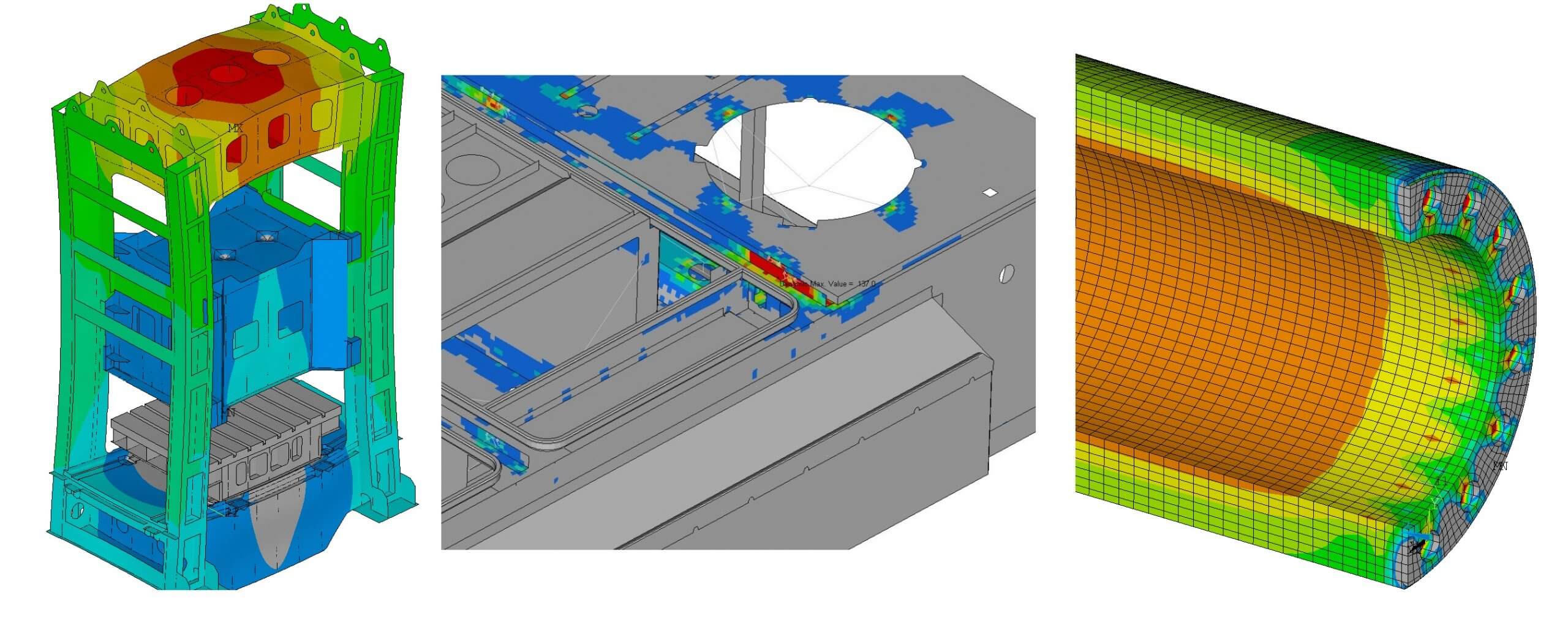
Our analysis add-ons automate the evaluation processes for the overall structure. Local geometric features, material properties, and superposition rules are processed algorithmically and made available for individual standard-based analysis. The result is a structure-wide, color-coded 3D visualization of utilization levels. Design engineers can immediately identify the actual risk of failure as well as local material reserves for targeted weight and cost optimization.
Would you like more details on how we can best support you with your product?
Take a look at our flyer or contact us for an initial discussion.
Would You like to contact us?
Gladly we are at your disposal for any questions!
Or call us: +49 (2154) 8874-0

