AI for component recognition
During the development of digital products, components in large 3D data sets must be constantly identified, understood and correctly assigned – a prerequisite for managing variants, tracking changes and reliably controlling subsequent processes. The more complex the product, the more important the transfer of information and clear structuring of geometries becomes.
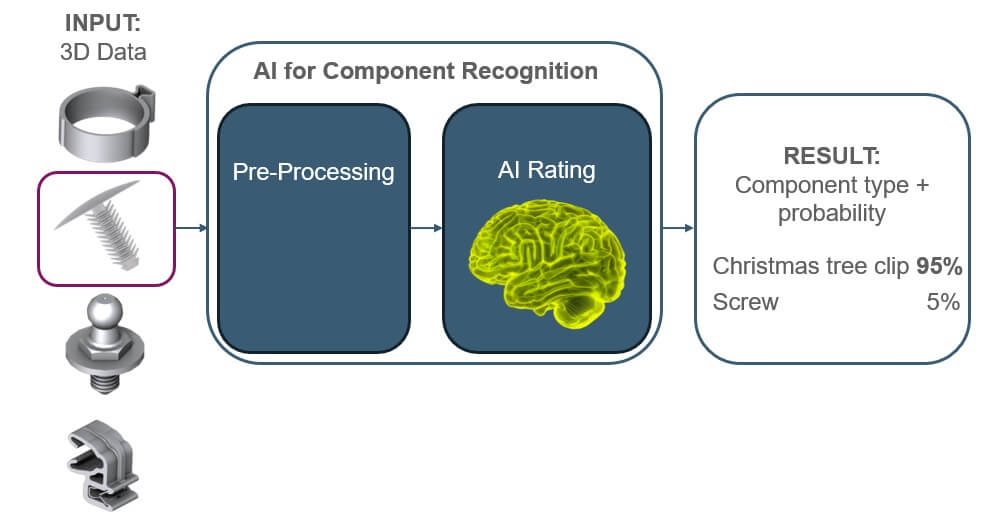
AI for component recognition covers the entire process of working with 3D data: It identifies and classifies components automatically, even in very large geometry sets, and provides additional context-related information. This creates a reliable database that speeds up subsequent processes, reduces errors and significantly increases transparency in the development process.
Status quo: manual component research, non-transparent data
Without AI, components often have to be searched for, identified and evaluated manually, which is time-consuming and error-prone for complex 3D models. Different designations, inconsistent structures and hidden information also make it difficult to reuse data and automate further processing.
Solution: end-to-end component recognition with AI
AI for component recognition is used to create the basis for the automatic creation of repair instructions, user evaluations or geometry checks. The AI recognises components automatically on the basis of their 3D geometry and classifies them reliably - regardless of designations or language variants. The basis is a trained neural network, which can be further trained with customer-specific data if required and is thus increasingly better adapted to individual requirements, component scopes and use cases.
Users benefit from fast, consistent component recognition, reduced error potential and a structured database for downstream processes such as evaluation, simulation or parts list creation. The result is faster development, less manual rework and noticeably higher data quality throughout the entire process.