AI for screw checks
Screws and other connecting elements are found in almost every technical product – from vehicles and machines to medical devices – and are crucial for stability, safety and functionality. Even the smallest deviations in geometry, alignment or installation situation can lead to difficult-to-recognise but critical errors in development and hardware.
As modern products consist of a large number of small parts, geometric problems often arise precisely where they are barely visible – for example, with minimally modified drill holes or incorrectly aligned fasteners. Manually checking these numerous screw connections in CAD is time-consuming, generates high modification costs (e.g. due to tools) and ties up valuable expertise.
To reduce risks, cut costs and free up skilled labour, we have developed an automated screw check together with an OEM: The AI for screw checks recognises screw connections in context, identifies even hidden geometric conflicts and provides AI-based additional information including clear evaluation suggestions for well-founded decisions.
Status quo: hidden errors, high testing effort – the needle in the haystack
These deviations are difficult to identify in virtual prototypes. Traditional inspection processes require manual checks of CAD data, are time-consuming, error-prone and hardly scalable – especially in view of the growing number of variants, frequent changes in the 3D data and increasing complexity of the products. Problems are often only discovered later in the hardware. This results in expensive rework and delays. Sometimes components even have to be scrapped.
Solution: automated screw checks using AI
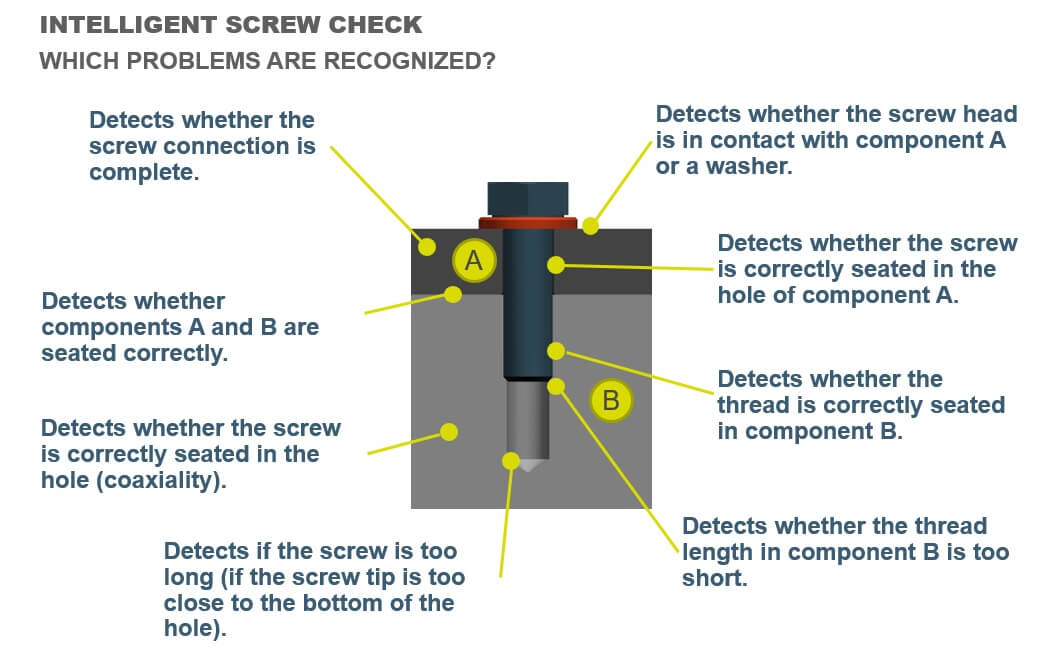
The AI for screw checks finds all screw connections in the entire digital product and checks each screw connection for completeness and geometric problems: it identifies relevant elements, analyses geometry and fit and detects alignment errors. The results are traceable, up-to-date at all times and significantly reduce the workload for experts.
This increases the quality of digital prototypes, identifies sources of error at an early stage and significantly reduces manual inspection work.
The solution will be gradually expanded to include other connecting elements in order to create a universal AI for automated quality inspection in the long term.