Co-learning AI for virtual geometric validation
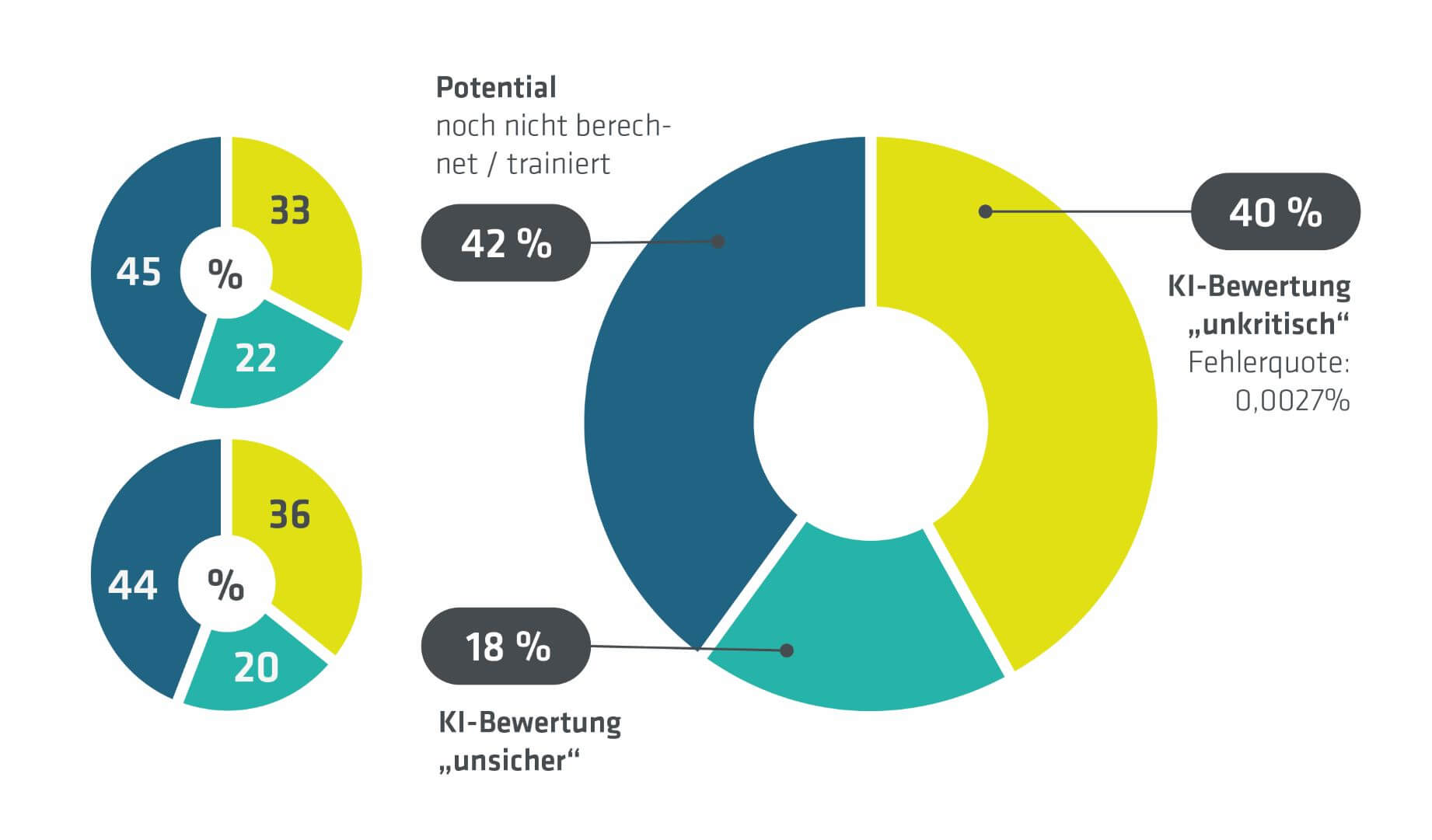
The co-learning AI builds on the established generic AI solution and extends virtual geometric validation (VGA) with continuous, customised learning. It uses historical decisions, current assessments and customer-specific data to adapt to the respective requirements and continuously learn about problem cases. The co-learning AI thus expands its knowledge of customer-specific data and situations. As a result, it can evaluate more relationships independently and is also much more efficient with new data sets.
Status quo: generic automation with a universal basis
The generic AI forms the solid foundation: it automates central process steps, visualises conflict points, provides evaluation suggestions and reduces manual effort. The solution can be used universally, increases the efficiency of the VGA process by up to 50 per cent and ensures that geometric conflicts can be assessed faster, more consistently and with less effort.
With AI learning, companies combine the stability and efficiency of the generic solution with individual customisation: the automated analysis is intelligently trained, continuously improved and enables fully digital, precise and efficient geometric validation.
Solution: continuous and individualised learning through AI that learns with you
The co-learning AI continuously learns from real assessments. Various factors such as component relationships, metadata and contextual information are taken into account for the training. As a result, the AI recognises that the same problem can be assessed differently depending on the context. Without co-learning mechanisms, experts still have to take these differences into account manually, which can lead to rework, queries and evaluation deviations despite automation.
The approach – it "looks over the user's shoulder" – ensures that their precision increases with each use. This reduces coordination loops, standardises decisions and significantly speeds up the entire VGA process. Depending on the level of training and confidence, the AI can provide suggestions or make its own judgements.
The co-learning AI is already being used productively and increases the efficiency of the VGA by 80 per cent. Thanks to its dynamic learning approach, it adapts individually to customer data, processes and assessment rules. The result: fewer manual assessments, faster decisions, less rework and a significantly leaner development process – with noticeably lower costs and higher data quality.