
AI for geometric similarity analysis
Many products consist of a large number of different components – from vehicles and agricultural machinery to industrial systems. This diversity complicates development, production and assembly processes and often leads to unnecessary complexity, higher costs and additional coordination efforts.
Because component variants can often grow uncontrollably, there is often a lack of transparency as to which components are actually similar or could easily be standardised. Manually searching through extensive CAD data is tedious, time-consuming and hardly scalable.
To help companies reduce variants at an early stage and make informed decisions, we have developed an AI for geometric similarity analysis: it automatically recognises similar components, groups them and classifies new geometries into existing structures. This creates the basis for a consistent common part strategy.
Status quo: high diversity of parts, no synergies
Over the years, many companies have accumulated a wide variety of parts that complicate development, production and assembly processes. Different variants make it difficult to structure data, lead to higher development costs and increase storage and procurement costs.
Solutions: geometric similarity analysis with AI as the basis for more identical parts
The AI for geometric similarity analysis analyses all 3D data, recognises geometric similarities based on definable percentage values and automatically assigns new components to the appropriate groups. Continuous monitoring of the data status ensures that new geometries are immediately sorted correctly and the quality of the results is constantly improving.
On this basis, companies can efficiently compare and select parts and consistently create identical parts. The solution simplifies structuring and sorting, reduces manual effort, lowers storage, production and development costs and creates a reliable basis for data-based decisions and a sustainable common part strategy.
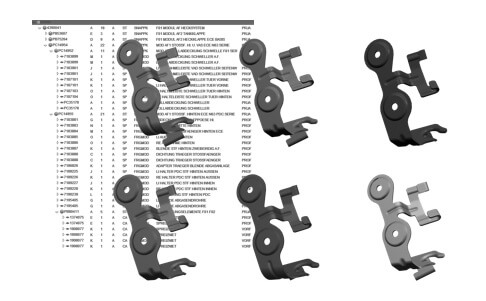
Use case: Grouping similar components
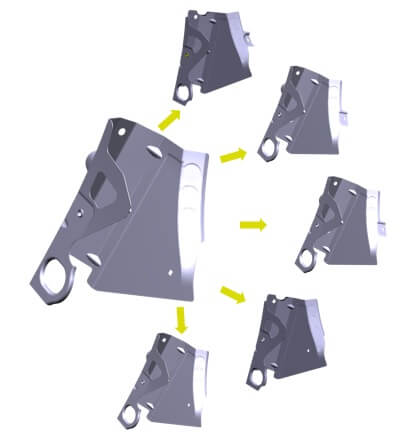
Use case: Finding similar components for a reference component